
Introduction
When someone searches for a product or service on Google, your business can appear in two main ways: through a paid advertisement or an organic search result. Both provide opportunities to connect with potential customers, increase website traffic and build brand awareness.
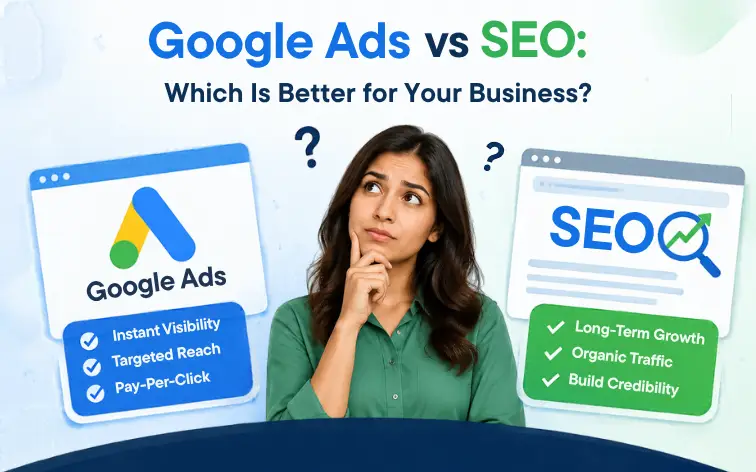
This is where Google Ads and SEO come in. Google Ads allows businesses to display paid advertisements at the top of Google search results and reach people who are actively looking for their products or services. SEO (Search Engine Optimisation), on the other hand, focuses on improving website content, technical performance and overall search visibility to attract organic traffic.
Although both strategies help businesses grow online, they work differently. Google Ads can generate traffic quickly, while SEO focuses on building long-term visibility and attracting relevant visitors over time. They also differ in advertising costs, competition, conversion opportunities and the time required to see results.
Choosing between Google Ads and SEO depends on your business goals, marketing budget and how quickly you want to reach your audience. In this blog, let’s explore the key differences between Google Ads and SEO, their benefits, limitations and how to choose the right strategy for your business.
Google Ads vs SEO: Quick Comparison
| Factor | Google Ads | SEO |
|---|---|---|
| Approach | Paid advertising | Organic optimization |
| Results | Faster paid visibility | Long-term organic growth |
| Cost | Advertising budget | Content and optimization investment |
| Traffic | Paid clicks | Organic clicks |
| Control | More control over targeting and budget | Less control over rankings |
| Best For | Quick promotions and lead generation | Long-term visibility and growth |
What Is Google Ads?
Google Ads is an online advertising platform that allows businesses to promote their products and services across Google’s advertising network.
For example, an electrical service company can run Search Ads targeting people searching for “emergency electrician near me”. Its advertisement may appear when the campaign is eligible in Google’s ad auction.
Many search campaigns use PPC (Pay-Per-Click) advertising, where businesses pay for clicks based on their bidding strategy.
Advantages of Google Ads
- Faster visibility: Reach potential customers without waiting for organic rankings.
- Targeted advertising: Target relevant searches, locations and audiences.
- Budget control: Set campaign budgets and manage advertising expenses.
- Quick promotions: Advertise seasonal offers, launches and special discounts.
- Performance tracking: Measure clicks, leads, conversions and advertising costs.
Types of Google Ads
- Search Ads: Text advertisements displayed on Google search results.
- Display Ads: Visual advertisements across websites and apps.
- Shopping Ads: Product advertisements featuring images and prices.
- Video Ads: Advertisements shown on YouTube and eligible video placements.
- App Campaigns: Campaigns designed to increase app installations and engagement.
- Performance Max: AI-powered campaigns across Google’s advertising channels.
- Demand Gen: Visual campaigns across YouTube, Discover and Gmail.
Remember: Google Ads does not directly improve organic search rankings. Paid visibility generally stops when advertising stops.
What Is SEO (Search Engine Optimization)?
SEO is the process of improving a website’s visibility in unpaid search results. It involves optimizing website content, technical performance, structure and authority to help search engines understand and discover relevant pages.
For example, a digital marketing agency can optimize its service pages for “SEO services in Chennai” and publish useful blogs about digital marketing.
Advantages of SEO
- Organic traffic: Attract visitors without paying for each organic click.
- Long-term visibility: Well-performing pages can continue attracting visitors.
- Brand credibility: Useful content helps build customer trust.
- Better user experience: Improve website structure, navigation and accessibility.
- Lead generation: Reach people actively searching for your services.
Types of SEO
- On-Page SEO: Optimizing content, headings, keywords, images and internal links.
- Technical SEO: Improving crawling, indexing, website speed and mobile usability.
- Off-Page SEO: Building quality backlinks and website authority.
- Local SEO: Improving visibility in location-based searches.
- E-commerce SEO: Optimizing product and category pages.
- Content SEO: Creating useful content that answers customer questions.
Traditional SEO vs Semantic SEO: What’s the Difference?
SEO is no longer just about adding keywords to website content. Search engines increasingly understand the meaning, context and intent behind search queries.
Traditional SEO focuses more on optimizing individual pages for specific keywords.
Semantic SEO focuses on topics, related concepts, entities and user search intent.
For example, for the keyword “Google Ads agency in Chennai”:
- Traditional SEO focuses on optimizing the page for the target keyword.
- Semantic SEO also covers related topics such as PPC management, Google Ads pricing, lead generation and conversion tracking.
| Traditional SEO | Semantic SEO |
|---|---|
| Keyword-focused | Topic-focused |
| Targets specific search terms | Covers related concepts |
| Focuses on keyword placement | Focuses on meaning and context |
| Optimizes individual pages | Connects related topics and pages |
Both approaches work together. Semantic SEO does not replace keyword research, technical SEO or on-page optimization.
How Is AI Changing SEO?
Google now provides AI-powered search experiences such as AI Overviews and AI Mode.
Businesses should focus on creating original, helpful and accurate content that answers users’ questions.
Important practices include:
- Write useful, people-first content.
- Answer questions clearly.
- Organize pages with meaningful headings.
- Use relevant images and internal links.
- Maintain a technically accessible website.
There is no special AI SEO trick required to appear in Google’s AI search experiences. Strong SEO fundamentals remain important.
Google Ads vs SEO: Which Is More Cost-Effective?
The cost depends on your industry, competition, marketing goals and available resources.
| Google Ads | SEO |
|---|---|
| Requires an advertising budget | Requires investment in content and optimization |
| Can generate traffic quickly | Builds organic traffic over time |
| Paid visibility depends on spending | Organic visibility may continue without ad spending |
| Campaign performance can be measured | Organic performance can be measured |
Neither channel is automatically cheaper. Compare lead quality, customer acquisition costs and revenue before deciding.
Important Digital Marketing Formulas
These simple formulas help businesses measure marketing performance.
- Cost Per Click (CPC)
CPC = Total Ad Spend ÷ Total Clicks
Example: ₹10,000 ÷ 500 clicks = ₹20 CPC.
- Click-Through Rate (CTR)
CTR = (Clicks ÷ Impressions) × 100
Example: (500 ÷ 10,000) × 100 = 5% CTR.
- Conversion Rate
Conversion Rate = (Conversions ÷ Total Visitors) × 100
Example: (50 enquiries ÷ 1,000 visitors) × 100 = 5%.
- Cost Per Lead (CPL)
CPL = Total Marketing Spend ÷ Total Leads
Example: ₹15,000 ÷ 75 leads = ₹200 per lead.
- Return on Ad Spend (ROAS)
ROAS = Revenue from Ads ÷ Advertising Spend
Example: ₹80,000 ÷ ₹20,000 = 4:1 ROAS.
These formulas help you understand whether your marketing investment is generating meaningful results. For accurate calculations, configure conversion tracking properly.
Should Your Business Choose Google Ads or SEO?
The right approach depends on your business goals.
Choose Google Ads if:
- You need faster paid visibility.
- You want to promote offers or new products.
- You need targeted advertising and measurable campaigns.
Choose SEO if:
- You want long-term organic traffic.
- You want to build online visibility and credibility.
- You want to attract customers through useful content.
Can you use both?
Absolutely! Google Ads can help generate immediate opportunities, while SEO builds organic visibility over time. Combining both can create a balanced digital marketing strategy.
Looking for Google Ads or SEO Services?
Not sure which strategy is right for your business? Clicktots helps businesses improve online visibility through targeted Google Ads campaigns and effective SEO strategies.
Explore our Google PPC advertising services and SEO services.
Contact Clicktots to find the right digital marketing strategy for your business.
1. Is Google Ads better than SEO for a new business?
Google Ads can provide faster paid visibility, while SEO helps build organic visibility over time. Choose based on your budget and business goals.
2. How long does SEO take to show results?
SEO has no guaranteed timeline. Results depend on competition, website quality, content and technical performance.
3. Does Google Ads improve SEO rankings?
No. Google Ads does not directly improve organic search rankings. Both channels work independently.
4. Can I do SEO myself?
Yes. You can start with keyword research, useful content, on-page optimization and internal linking. Advanced technical SEO may require professional support.
5. What is the difference between Traditional SEO and Semantic SEO?
Traditional SEO focuses on specific keywords, while Semantic SEO focuses on the meaning, context and relationships between topics and search queries.